


Discover and Play with this Demo of the Open Semantic Framework
Today, Structured Dynamics is pleased to make its Citizen Dan application available for public viewing, play and downloading for the first time.
Citizen Dan is a free, open source system available to any community and its citizens to measure and track indicators of local well being. It can be branded and themed for local needs. It is under active development by Structured Dynamics with support from a number of innovative cities.
Citizen Dan is an exemplar instance of Structured Dynamics’ open semantic framework (OSF), a generalized framework for deploying semantic platforms for any domain. By changing its guiding ontologies and source content and data, what appears for Citizen Dan can be adopted for virtually any subject area.
As configured, the Citizen Dan OSF instance is a:
- Appliance for slicing-and-dicing and analyzing data specific to local community indicators
- Framework for dynamically navigating, interacting with, or browsing data and concepts
- Means to visualize local data over time or by neighborhood
- Meeting place for the public to upload and share local data and information
- Web data portal that can be individually tailored by any local community
- Potential node in a global network of communities across which to compare indicators of community well-being.
Citizen Dan’s information sources may include Census data, the Web, real-time feeds, government datasets, municipal government information systems, or crowdsourced data. Information can range from standard structured data to local narratives, including from minutes and reports, contributed stories, blogs or news outlets. The ‘raw’ input data can come in essentially any format, which is then converted to a standard form with consistent semantics.
Text and narratives and the concepts and entities they describe are integrally linked into the system via information extraction and tagging. All ingested information, whether structured or text sources, with their semantics, can be exported in multiple formats. A standard organizing schema, also open source and extensible or modifiable by all users, is provided via the optional MUNI ontology (with vocabulary details in development here), being developed expressly for Citizen Dan and its community indicator system purposes.
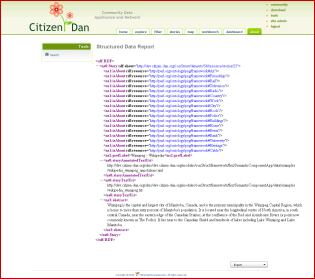
All of the community information contained within a Citizen Dan instance is available as linked data.
Overview of Features
Here are the main components or widgets to this Citizen Dan demo:
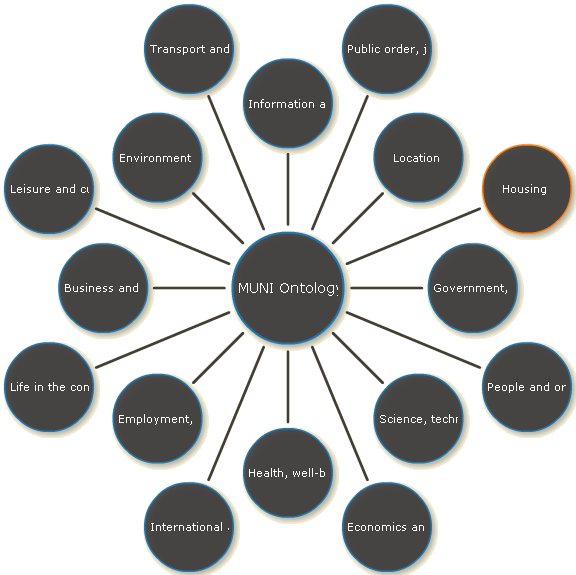
- Concept Explorer — this Flex widget (also called the Relation Browser) is a dynamic navigator of the concept space (ontology) that is used to organize the content on the instance. Clicking on a bubble causes it to assume the central position in the diagram, with all of its connecting concepts shown. Clicking on a branch concept then causes that new node to assume the central position, enabling one to “swim through” the overall concept graph. For this instance of Citizen Dan, the MUNI ontology is used; a diagram shows the full graph of the MUNI structure. See further the concept explorer’s technical documentation
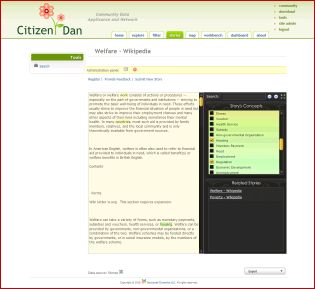
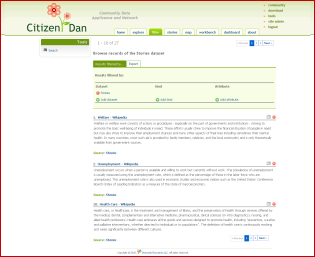
- Story Viewer — any type of text content (such as stories, blog posts, news articles, local government reports, city council minutes, etc.) can be submitted to the system. This content is then tagged using the scones system (subject concepts or named entities), which then provides the basis for linking the content with concepts and other data. The story viewer is a Flex widget that highlights these tags in the content and allows searches for related content based on selected tags. See further the story viewer’s technical documentation
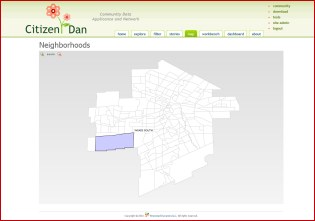
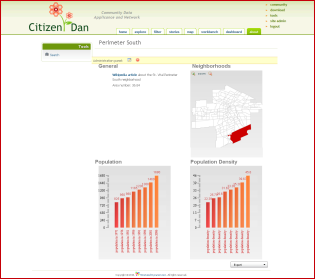
- Map Viewer — the map viewer is a Flex widget that presents layered views of different geographic areas. The title bar of the viewer allows different layers to be turned on and off. Clicking on various geographic areas can invoke specific data and dashboard views. See further the map viewer’s technical documentation
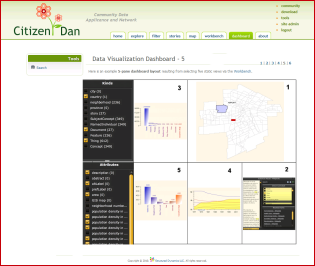
- Charting Widgets — the system provides a variety of charting options for numeric data, including pie, line and bar charts. These can be called directly or sprinkled amongst other widgets based on a dashboard specification (see below)
- Filter Component — the filter, or browse, component provides the ability to slice-and-dice the information space by a choice of dataset, type of data or data attribute. These slices then become filter selections which can be persisted across various visualizations or exports. See further the browse component’s technical documentation
- Search Component — this component provides full-text, faceted search across all content in the system; it may be used in conjunction with the filtering above to restrict the search space to the current slice. See further the search tool’s technical documentation
- Dashboard Viewer — a dashboard is a particular layout of one or more visualization widgets and a set (or not) of content filtering conditions to be displayed on a canvas. Dashboard views are created in the workbench (see next) and given a persistent name for invoking and use at any other location in the application
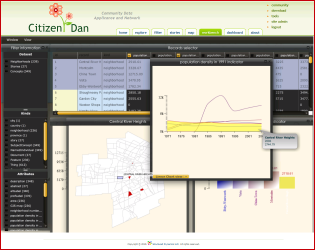
- Workbench — this rather complex component is generally intended to be limited to site administrators. Via the workbench, records and datasets and attributes may be selected, and then particular views or widgets obtained. When no selections are made in the left-hand panel, all are selected by default. Then, in the records viewer (middle upper), either records or attributes are selected. For each attribute (column), a new display widget appears. All display widgets interact (a selection in one reflects in the others). The nature of the data type or attribute selected determines which available widgets are available to display it; sometimes there are multiples which can be selected via the lower left dropdown list in any given display panel. These various display widgets may then be selected for a nameable layout as a persistent dashboard view (functionality not shown in this public demo)
- Exporter —
 the exporter component appears in multiple locations across the appliance, either as a tab option (e.g., Filter component) or as a dropdown list to the lower right of many screens. A variety (and growing!) number of export formats are available. When it appears as a dropdown list, the export is limited to the currently active slice. When invoked via tab, more export selection options are available. See further the technical documentation for this component
Limitations of the Online Demo
A number of other tools are available to admins in the actual appliance, but are not exposed in the demo:
- Importer — like the exporter, there are a variety of formats supported for ingesting data or content into the system. Prominent ones include spreadsheets (CSV), XML and JSON. The irON notation is especially well suited for dataset staging for ingest. At import time, datasets can also be appended or merged. See further the technical documentation for this component
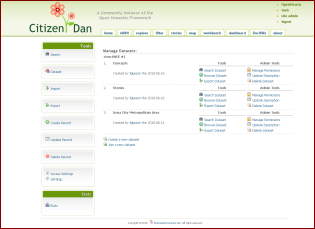
- Dataset Submission and Management — new datasets can be defined, updated, deleted, appended and granted various access rights and permissions, including to the granularity of individual components or tools. For example, see further this technical documentation
- Records Manager — every dataset can have its records managed via so-called CRUD rights. Depending on the dataset permissions, a given user may or may not see these tools. See further the technical documentation for each of these create – read – update – delete tools.
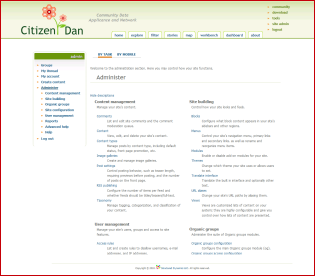
In addition, it is not possible in the demo to save persistent dashboard views or submit stories or documents for tagging, nor to register as a user or view the admin portions of the Drupal instance.
Sample Data and Content in the Demo
The sample data and content in the demo is for the Iowa City (IA) metropolitan statistical area. This area embraces two counties (Johnson and Washington) and the census tracts and townships that comprise them, and about two dozen cities. Two of the notable cities are Iowa City itself, home of the University of Iowa, and Coralville, where Structured Dynamics, the developer of Citizen Dan and the open semantic framework (OSF), is headquartered.
The text content on this site is drawn from Wikipedia articles dealing with this area. About 30 stories are included.
The data content on the site is drawn from US Census Bureau data. Shape files for the various geographic areas were obtained from here, and the actual datasets by geographic area can be obtained from here.
An Instance of the Open Semantic Framework
Citizen Dan is an exemplar instance of Structured Dynamics’ open semantic framework (OSF), a generalized framework for deploying semantic platforms for specific domains.
OSF is a combination of a layered architecture and modular software. Most of the individual open source software products developed by Structured Dynamics and available on the OpenStructs site are components within the open semantic framework. These include:
- conStruct Drupal modules
- structWSF Web services framework
- semantic components (Flex widgets), and
- irON (instance record object notation) for dataset ingest and exchange.
A Part of the ‘Total Open Solution‘
The software that makes up the Citizen Dan appliance is one of the four legs that provide a stable, open source solution. These four legs are software, structure, methods and documentation. When all four are provided, we can term this a total open solution.
For Citizen Dan, the complements to this software are:
- MUNI ontology, which provides the structure specification upon which the software runs, and
- DocWiki (with its TechWiki subset of technical documentation) that provides the accompanying knowledge base of methods, best practices and other guidance.
In its entirety, the total open solution amounts to a form of capacity building for the enterprise.
The Potential for a Citizen Dan Network
Inherent in the design and architecture of Citizen Dan is the potential for each instance (single installation) to act as a node in a distributed network of nodes across the Web. Via the structWSF Web service endpoints and appropriate dataset permissions, it is possible for any city in the Citizen Dan network to share (or not) any or all of its data with other cities.
This collaboration aspect has been “baked into the cake” from Day One. The system also supports differential access, rights and roles by dataset and Web service. Thus, city staffs across multiple communities could share data differently than what is provided to the general public.
Since all data management aspects of each Citizen Dan instance is also oriented around datasets, expansion to a network mode is quite straightforward.
How to Get the System
The Citizen Dan appliance is based on the Drupal content management system, which means any community can easily theme or add to the functionality of the system with any of the available 6500 open source modules that extend the basic Drupal functionality.
All other components, including the multiple third-party ones, are also open source.
To install Citizen Dan for your own use, you need to:
- Download and install all of the software components. You may also want to check out the OSF discussion forum for tips and ideas about alternative configuration options
- Install a baseline vocabulary. In the case of Citizen Dan, this is the MUNI ontology. MUNI is imminent for public release. Please contact the project if you need an early copy
- Install your own datasets. You may want to inspect the sample Citizen Dan datasets and learn more about the irON notation, especially its commON (spreadsheet) use case.
(Note: there will also be some more updates in August, including the MUNI release.)
For questions and additional info, please consult the TechWiki or the OpenStructs community site.
Finally, please contact us if you’d like to learn more about the project, investigate funding or sponsorship opportunities, or contribute to development. We’d welcome your involvement!