


 Pinheads Sometimes Get the Last Laugh
The idea of the ‘long tail’ was brilliant, and Chris Anderson’s meme has become part of our current lingo in record time. The long tail is the colloquial name for a common feature in some statistical distributions where an initial high-amplitude peak within a population distribution is followed by a rapid decline and then a relatively stable, declining low-amplitude population that “tails off.” (An asymptotic curve.) This sounds fancy; it really is not. It simply means that a very few things are very popular or topical, most everything else is not.
The following graph is a typical depiction of such a statistical distribution with the long tail shown in yellow. Such distributions often go by the names of power laws, Zipf distributions, Pareto distributions or general Lévy distributions. (Generally, such curves when plotted on a semi-logarithmic scale now show the curve to be straight, with the slope being an expression of its “power”.)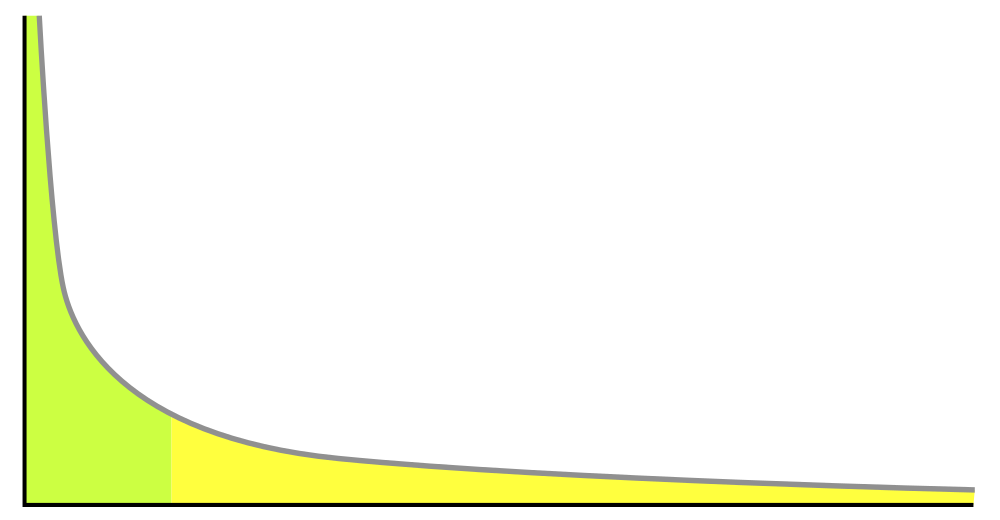
It is a common observation that virtually everything measurable on the Internet — site popularity, site traffic, ad revenues, tag frequencies on del.icio.us, open source downloads by title, Web sites chosen to be digg‘ed, Google search terms — follows such power laws or curves.
However, the real argument that Anderson made first in Wired magazine and then in his 2006 book, The Long Tail: Why the Future of Business is Selling Less of More, is that the Internet with either electronic or distributed fulfillment means that the cumulative provision of items in the long tail is now enabling the economics of some companies to move from “mass” commodities to “specialized” desires. Or, more simply put: There is money to be made in catering to individualized tastes.
I, too, agree with this argument, and it is a brilliant recognition of the fact that the Internet changes everything.
But Long Tails Have ‘Teeny Heads’
Yet what is amazing about this observation of long tails on the Internet has been the total lack of discussion of its natural reciprocal: namely, long tails have teeny heads, the red portion of the diagram. For, after all, what also is the curve above telling us? While Anderson’s point that Amazon can carry millions of book titles and still make a profit by only selling a few of each, what is going on at the other end of the curve — the head end of the curve?
Well, if we’re thinking about book sales, we can make the natural and expected observation that the head end of the curve represents sales of the best seller books; that is, all of those things in the old 80-20 world that is now being blown away with the long tail economics of the Internet. Given today’s understandings, this observation is pretty prosaic since it forms the basis of Anderson’s new long tail argument. Pre-Internet limits (it’s almost like saying before the Industrial Revolution) kept diversity low and choices few.
Okaaaay! Now that seems to make sense. But aren’t we still missing something? Indeed we are.
Social Collaboration Depends on ‘Teeny Heads’
So, when we look at many of those aspects that make up what is known as Web 2.0 or even the emerging semantic Web, we see that collaboration and user-submitted content stands at the fore. And our general power law curves then also affirm that it is a very few who supply most of that user-generated content — namely, those at the head end, the teeny heads. If those relative few individuals are not motivated, the engine that drives the social content stalls and stutters. Successful social collaboration sites are the ones that are able to marshal “large numbers of the small percentage.”
The natural question thus arises: What makes those “teeny heads” want to contribute? And what makes it so they want to contribute big — that is, frequently and with dedication? So, suddenly now, here’s a new success factor: to be successful as a collaboration site, you must appeal to the top 1% of users. They will drive your content generation. They are the ‘teeny heads’ at the top of your power curve.
Well, things just got really more difficult. We need tools, mindshare and other intangibles to attract the “1%” that will actually generate our site’s content. But we also need easy frameworks and interfaces for the general Internet population to live comfortably within the long tail.
So, heads or tails? Naahh, that’s the wrong question. Keep flipping until you get both!
 This Friday brown bag leftover was first placed into the AI3 refrigerator on April 6, 2007. I remain convinced that only a few “movers” are required to start shaking the user-generated content tree. I made two changes from the original post: 1) I had to find a grainy replacement for the initial great graphic of the “teeny head”; and 2) I added the red portion to the graphic. No other changes have been made.
Before you join the legions of MBAs uncritically repeating Anderson’s meme, I recommend reading Tom Slee’s critical reader’s companion to The Long Tail.