


The first recorded mentions of “semi-structured data” occurred in two academic papers from Quass et al.[1] and Tresch et al.[2] in 1995. However, the real popularization of the term “semi-strucutred data” occurred through the seminal 1997 papers from Abiteboul, “Querying semi-structured data,” [3] and Buneman, “Semistructured data.” [4] Of course, semi-structured data had existed well before this time, only it had not been named as such.
What is Semi-structured Data?
Peter Wood, a professor of computer science at Birkbeck College at the University of London, provides succinct definitions of the “structure” of various types of data:[5]
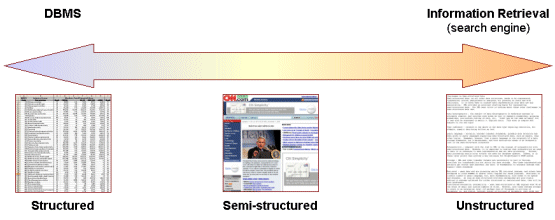
- Structured Data — or classes. Entities in the same group have the same descriptions (or attributes), while descriptions for all entities in a group (or schema): a) have the same defined format; b) have a predefined length; c) are all present; and d) follow the same order. Structured data are what is normally associated with conventional databases such as relational transactional ones where information is organized into rows and columns within tables. Spreadsheets are another example. Nearly all understood database management systems (DBMS) are designed for structural data
- Unstructured Data — in this form, data can be of any type and do not necessarily follow any format or sequence, do not follow any rules, are not predictable, and can generally be described as “free form.” Examples of unstructured data include text, images, video or sound (the latter two also known as “streaming media”). Generally, “search engines” are used for retrieval of unstructured data via querying on keywords or tokens that are indexed at time of the data ingest, and
- Semi-structured Data — the idea of semi-structured data predates XML but not HTML (with the actual genesis better associated with SGML, see below). Semi-structured data are intermediate between the two forms above wherein “tags” or “structure” are associated or embedded within unstructured data. Semi-structured data are organized in semantic entities, similar entities are grouped together, entities in the same group may not have same attributes, the order of attributes is not necessarily important, not all attributes may be required, and the size or type of same attributes in a group may differ. To be organized and searched, semi-structured data should be provided electronically from database systems, file systems (e.g., bibliographic data, Web data) or via data exchange formats (e.g., EDI, scientific data, XML).
Unlike structured or unstructured data, there is no accepted database engine specific to semi-structured data. Some systems attempt to use relational DBMS approaches from the structured end of the spectrum; other systems attempt to add some structure to standard unstructured search engines. (This topic is discussed in a later section.)
Semi-structured data models are sometimes called “self-describing” (or schema-less). These data models are often represented as labelled graphs, or sometimes labelled trees with the data stored at the leaves. The schema information is contained in the edge labels of the graph. Semi-structured representations also lend themselves well to data exchange or the integration of heterogeneous data sources.
A nice description by David Loshin[6] on Simple Semi-structured Data notes that structured data can be easily modeled, organized, formed and formatted in ways that are easy for us to manipulate and manage. In contrast, though we are all familiar with the unstructured text in documents, such as articles, slide presentations or the message components of emails, its lack of structure prevents the advantages of structured data management. Loshin goes on to describe the intermediate nature of semi-structured data:
There [are] sets of data in which there is some implicit structure that is generally followed, but not enough of a regular structure to “qualify” for the kinds of management and automation usually applied to structured data. We are bombarded by semi-structured data on a daily basis, both in technical and non-technical environments. For example, web pages follow certain typical forms, and content embedded within HTML often have some degree of metadata within the tags. This automatically implies certain details about the data being presented. A non-technical example would be traffic signs posted along highways. While different areas use their own local protocols, you will probably figure out which exit is yours after reviewing a few highway signs.
This is what makes semi-structured data interesting–while there is no strict formatting rule, there is enough regularity that some interesting information can be extracted. Often, the interesting knowledge involves entity identification and entity relationships. For example, consider this piece of semi-structured text (adapted from a real example):
John A. Smith of Salem, MA died Friday at Deaconess Medical Center in Boston after a bout with cancer. He was 67.
Born in Revere, he was raised and educated in Salem, MA. He was a member of St. Mary’s Church in Salem, MA, and is survived by his wife, Jane N., and two children, John A., Jr., and Lily C., both of Winchester, MA.
A memorial service will be held at 10:00 AM at St. Mary’s Church in Salem.
This death notice contains a great deal of information–names of people, names of places, relationships between people, affiliations between people and places, affiliations between people and organizations and timing of events related to those people. Realize that not only is this death notice much like others from the same newspaper, but that it is reasonably similar to death notices in any newspaper in the US.
Note in Loshin’s example that the “structure” added to the unstructured text (shown in yellow; my emphasis) to make this “semi-structured” data arises from adding informational attributes that further elaborate or describe the document. These attributes can be automatically found using “entity extraction” tools or similar information extraction (IE) techniques, or manually identified. [7] These attributes can be assigned to pre-defined record types for manipulation separate from a full-text seach of the document text. Generally, when such attributes are added to the core unstructured data it is done through “metatags” that a parser can structurally recognize, such as by using the common open and close angle brackets. For example:
<author=John Smith>
In semi-structured HTML, the tags that provide the semi-structure serve a different purpose in terms of either formatting instructions to a browser or providing reference links to internal anchors or external documents or pages. Note that HTML also uses the open and close angle brackets as the convention to convey the structural information in the document.
The Birth of the Semi-structured Data Construct
One could argue that the emergence of the “semi-structured data” construct arose from the confluence of a number of factors:
- The emergence of the Web
- The desire for extremely flexible formats for data exchange between disparate databases (and therefore useful for data federation)
- The usefulness of expressing structured data in a semi-structured way for the purposes of browsing
- The growth of certain scientific databases, especially in biology (esp., ACeDB), where annotations, attribute extensibility resulting from new discoveries, or a broader mix of structural and text data was desired.[8]
These issues first arose and received serious computer science study in the late 1970s and early 1980s. In the early years of trying to find standards and conventions for representing semi-structured data (though not yet called that), the major emphasis was on data transfer protocols.
In the financial realm, one proposed standard was electronic data interchange (EDI). In science, there were literally tens of exchange forms proposed with varying degrees of acceptance, notably abstract syntax notation (ASN.1), TeX (a typesetting system created by Donald Knuth and its variants such as LaTeX), hierarchical data format (HDF), CDF (common data format), and the like, as well as commercial formats such as Postscript, PDF (portable document format), RTF (rich text format), and the like.
One of these proposed standards was the “standard generalized markup language” (SGML), first published in 1986. SGML was flexible enough to represent either formatting or data exchange. However, with its flexibility came complexity. Only when two simpler forms arose, namely HTML (HyperText Markup Language) for describing Web pages and XML (eXtensible Markup Language) for data exchange, did variants of the SGML form emerge as widely used common standards.[9]
The XML standard was first published by the W3C in February 1998, rather late in this history and after the semi-structured data term had achieved some impact.[10] Dan Suciu was the first to publish on the linkage of XML to semi-structured data in 1998,[11] a reference that remains worth reading to this day.
In addition, the OEM (Object Exchange Model) has become the de facto model for semi-structured data. OEM is a graph-based, self-describing object instance model. It was originally introduced for the Tsimmis data integration project,[12] and provides the intellectual basis for object representation in a graph structure with objects either being atomic or complex.
How the attribute “metadata” is described and associated has itself been the attention of much standards work. Truly hundreds of description standards have been proposed from specific instances in medical terminology such as MESH to law to physics to engineering and to cross-discipline proposed standards such as the Dublin core. (Google these for a myriad of references.)
Challenges in Semi-structured Data
Semi-structured data, as for all other data structures, needs to be represented, transferred, stored, manipulated or analyzed, all possibly at scale and with efficiency. It is often easy to confuse data representation from data use and manipulation. XML provides an excellent starting basis for representing semi-structured data. But XML says little or nothing about these other challenges in semi-structured data use:
- Data heterogeneity — the subject of data heterogeneity in federated systems is extremely complex, and involves such areas as unit or semantic mismatches, grouping mismatches, non-uniform overlap of sets, etc. “Glad” may be the same as”happy” but it may also be expressed in metric v. English units. This area is complex and subject to its own topic
- Type inference — related to the above is the data type requiring resolution, for example, numeric data being written as text
- Query language — actually, besides transfer standards, probably more attention has been given to query languages supporting semi-structured data, such as XQuery, than other topics. Remember, however, that a query language is the outgrowth of a data storage framework, not a determinant, and this distinction seems to be frequently lost in the semi-structured literature
- Extensibility — inherent with the link to XML is the concept of extensibility with semi-structured data. However, it is important to realize that extensibility as used to date is in reference to data representation and not data processing. Further, data processing should occur without the need for database updates. Indeed, it is these later points that provide a key rationale for BrightPlanet‘s XSDM system
- Storage — XML and other transfer formats are universally in text or Unicode, excellent for transferability but shitty for data storage. How these representations actually get stored (and searched, see next) is fundamental to scalable systems that support these standards
- Retrieval — many have and are proposing native XML retrieval systems, and others have attempted to clone RDBMSs or search (text) engines for these purposes. Retrieval is closely linked to query language, but, more fundamentally, also needs to be speedy and scalable. As long as semi-structured retrieval mechanisms are poor-cousin add-ons to systems optimized for either structured or unstructured data, they will be poor performers
- Distributed evaluation (scalability) — most semi-structured or XML engines work OK at the scale of small and limited numbers of files. However, once these systems attempt to scale to an enterprise level (of perhaps tens of thousands to millions of documents) or, god forbid, Internet scales of billions of documents, they choke and die. Again, data exchange does not equal efficient data processing. The latter deserves specific attention in its own right, which has been lacking to date
- Order — consider a semi-structured data file transferred in the standard way (which is necessary) as text. Each transferred file will contain a number of fields and specifications. What is the efficient order of processing this file? Can efficiencienes be gained through a “structural” view of its semi-structure? Realize that any transition from text to binary (necessary for engine purposes, see above), also requires “smart” transformation and load (TL) approaches. There is virtually NO discussion of this problem in the semi-strucutred data literature
- Standards — while XML and its variants provide standard transfer protocols, the use of back-end engines for efficient semi-structured data processing also requires prescribed transfer standards in order to gain those efficiencies. Because the engines are still totally lacking, this next level of prescribed formats is lacking as well.
Generally, most academic, open source, or other attention to these problems has been at the superficial level of resolving schema or definitions or units. Totally lacking in the entire thrust for a semi-structured data paradigm has been the creation of adequate processing engines for effiicient and scalable storage and retrieval of semi-structured data. [13]
You know, it is very strange. Tremendous effort goes into data representations like XML, but when it comes to positing or designing engines for manipulating that data the approach is to clone kludgy workarounds on to existing relational DBMSs or text search engines. Neither meet the test.
Thus, as the semantic Web and its association to semi-structured data looks forward, two impediments stand like gatekeepers blocking forward progress: 1) efficient processing engines and 2) scalable systems and architectures.
[1] D. Quass, A. Rajaraman, Y. Sagiv, J. Ullman and J. Widom, “Querying Semistructured Heterogeneous Information,” presented at Deductive and Object-Oriented Databases (DOOD ’95), LNCS, No. 1013, pp. 319-344, Springer, 1995.
[2] M. Tresch, N. Palmer, and A. Luniewski, “Type Classification of Semi-structured Data,” in Proceedings of the International Conference on Very Large Data Bases (VLDB), 1995.
[3] Serge Abiteboul, “Querying Semi-structured data,” in International Conference on Data Base Theory (ICDT), pp. 1 – 18, Delphi, Greece, 1997. See http://dbpubs.stanford.edu:8090/pub/1996-19.
[4] Peter Buneman, “Semistructured Data,” in ACM Symposium on Principles of Database Systems (PODS), pp. 117 – 121, Tucson, Arizona, May 1997. See http://db.cis.upenn.edu/DL/97/Tutorial-Peter/tutorial-semi-pods.ps.gz
[5] Peter Wood, School of Computer Science and Information Systems, Birkbeck College, the University of London. See http://www.dcs.bbk.ac.uk/~ptw/teaching/ssd/toc.html.
[6] David Loshin, “Simple Semi-structured Data,” Business Intelligence Network, October 17, 2005. See http://www.b-eye-network.com/view/1761.
[7] This example is actually quite complex and demonstrates the challenges facing “entity extraction” software. Extracted entities most often relate to the nouns or “things” within a document. Note also, for example, how many of the entities involve internal “co-referencing,” or the relation of subjects such as “he” to times such as “10 a.m” to specific dates. A good entity extraction engine helps resolve these so-called “within document co-references.”
[8] Peter Buneman, “Semistructured Data,” in ACM Symposium on Principles of Database Systems (PODS), pp. 117 – 121, Tucson, Arizona, May 1997. See http://db.cis.upenn.edu/DL/97/Tutorial-Peter/tutorial-semi-pods.ps.gz
[9] A common distinction is to call HTML “human readable” while XML is “machine readable” data.
[10] W3C, XML Development History. See http://www.w3.org/XML/hist2002.
[11] Dan Suciu, “Semistructured Data and XML,” in International Conference on Foundations of Data Organization (FODO), Kobe, Japan, November 1998. See PDF option from http://citeseer.ist.psu.edu/suciu98semistructured.html.
[12] Y. Papakonstantinou, H. Garcia-Molina and J. Widom, “Object Exchange Across Heterogeneous Information Sources,” in IEEE International Conference on Data Engineering, pp. 251-260, March 1995.
[13] Matteo Magnani and Danilo Montesi, “A Unified Approach to Structured, Semistructured and Unstructured Data,” Technical Report UBLCS-2004-9, Department of Computer Science, University of Bologna, 29 pp., May 29, 2004. See http://www.cs.unibo.it/pub/TR/UBLCS/2004/2004-09.pdf.
| NOTE: This posting is part of an occasional series looking at a new category that I and BrightPlanet are terming the eXtensible Semi-structured Data Model (XSDM). Topics in this series cover all information related to extensible data models and engines applicable to documents, metadata, attributes, semi-structured data, or the processing, storing and indexing of XML, RDF, OWL, or SKOS data. A major white paper will be produced at the conclusion of the series. Stay tuned! |

Your history of semistructured data is informative and interesting. I ran across some early references to semistructured data on the ACM Digital Library. I did not see any of your references that were this old, so I thought I would pass them along.
The first was published in 1992 and comes from Belkin, Nicholas J. and Croft, W. Bruce in Communications of the ACM Volume 35, Issue 12 (December 1992) Pages: 29 – 38, Special issue on information filtering. Its title is: Information filtering and information retrieval: two sides of the same coin? The quote is
The second is a definition. It appears in 1993, authored by Peter Schäuble in Proceedings of the 16th annual international ACM SIGIR conference on Research and development in information retrieval pages: 318 – 327. The title is: SPIDER: a multiuser information retrieval system for semistructured and dynamic data, and the definition is:
I look forward to the follow-on installments.
Very cool, Tom.
I will include these earlier references in the eventual paper that is to be produced from all of this XSDM stuff.
Does anyone else have still earlier references than what Tom provided?
This article is an excellent resource (and apparantly unique one on the web.) congrats.
To respond to your penultimate paragraph : “You know, it is very strange. Tremendous effort goes into data representations like XML, but when it comes to positing or designing engines for manipulating that data the approach is to clone kludgy workarounds on to existing relational DBMSs or text search engines. Neither meet the test.”
This is because XML is a hierarchical (or at a stretch network) model – manipulation of these data models is a proven quagmire, and the exact reason relational database came to the fore 30 years ago. XML is all about structure, which is only part of the story in info management.
Semi-structured data will require _far more_ than XML to solve it, and Codd’s RM work must be re-examined, lessons extracted and applied to semistructure for advances to be achieved.