


NOTE: This is an update of an 2005 post.
There has been a massive — but little noticed — shift in enterprise software expenditures and software company revenues in the past decade. A "typical" enterprise software vendor could expect to obtain 70% or more of its total revenues from software license fees a decade ago. Today, that percentage is about 35% with statistically significant trends heading toward below 10% within the decade. These trends have signficant implications on the emerging business models necessary for software companies to be successful.
The Trends and Data
The figure below provides software license revenues as a percent of total revenues for about 120 different software companies over the past decade. No matter the sample, there has been a steady — and signficantly strong — trend to declining license revenues.
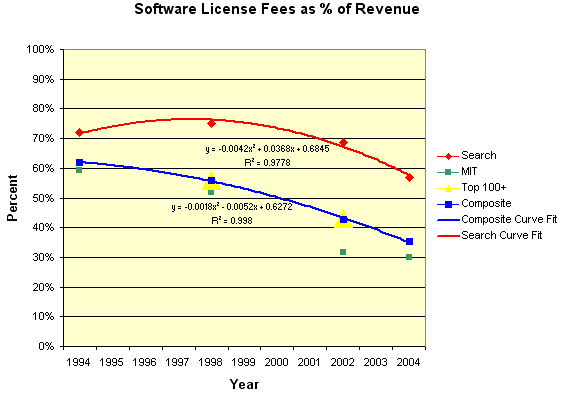
The three sources for this figure are:
- Search – my own values for Autonomy and Convera from SEC filings
- Top 100 – these are listings compiled by Culpeper and Associates[2]
- MIT – these values are from the MIT Sloan School of Management, using eight leading companies as referenced by Michael Cusumano [3]
The trend lines indicate continued percentage declines in the importance of software licensing. Based on these teyear trends, by 2008 conventional software licenses will account for less than 10% of total revenues for all software companies, and less than 20% for leading enterprise search vendors (Verity [now part of], Autonomy, Convera). These trends have very high R2 values. Seven-fold or greater drops from a position of dominance suggests a sea change is taking place in the revenue mix for software companies and the expenditure mix for enterprises.
These trends can vary significantly by software company, as the comparison table I constructed from recent SEC filings below shows:
Company |
License Revenue % |
| Red Hat | 0.0% |
| salesforce.com | 0.0% |
| i2 | 15.0% |
| Compuware | 23.5% |
| Peoplesoft | 23.7% |
| IBM | 24.6% |
| SAP | 31.4% |
| Oracle | 34.9% |
| INDUSTRY AVERAGE | 35.4% |
| Siebel | 36.4% |
| Business Objects | 51.1% |
| Microsoft | 76.5% |
| Adobe | 90.0% |
These values are derived from the most recent SEC filings (10Ks or 10Qs). This table shows that companies that can truly "package" shrink-wrapped software can maintain the highest percentages of software license revenues; vendors that rely on the subscription model have the lowest percentage, often going to zero. Large, traditional software vendors such as IBM or Oracle are below industry averages for the percent of software license percentages. This trend is remarkable given that these larger vendors obtained 70-80% or more of their total software revenues from license fees a mere decade ago.
The abiding trend appears to be the shift from software to services, but the picture is considerably more complicated than that.
Other Software Licensing Studies
At least two comprehensive studies have been issued in the past year or so regarding software licensing trends. The first, from IDC that involved Delphi interviews of 100 large customers and 100 major software vendors, was conducted with the support of 11 major vendors and the Software and Information Industry Association (SIIA). [1] This study sees subscription licenses having increasing importance to vendor revenues.
This study shows that companies today budget 20% for maintenance contracts, 32% for new licenses. IDC projects that maintenance expenditures are likely to increase, license to decline. With an increased reliance on a subscription model, maintenance in fact increases as a source of revenue to the vendor. IDC projects 34% of revenue to come from subscriptions by 2008. Though the worldwide software market was about $200 billion in 2003, growth will continue, with changing fractions of the sources of revenue. Besides subscription models, maintenance fees and consulting and service fees are projected to increase while standard license fees decrease. Vendor drivers for these trends include the long lead times of traditional enterprise software license sales and the need for more predictable revenue streams. Customer drivers for these trends are demands for lower overall costs, a better alignment of value, and the requirement for smaller upfront costs.
The second study from Macrovision used a questionnaire methodology directed to a larger group of software executives and a similar number of customers. [4] This study, too, was conducted in association with SIIA. This later study, completed in late 2004, also sees subscription licenses increasing. Vendors reported a trend to subscription licensing to become 67% of license revenues, though customers exhibited more reluctance to embrace the subscription model.
Both studies showed maintenance fees to average 20-22% of initial software license fees.
What Changing Business Models are Emerging?
While the trend moving away from standard software licenses is clear, what that means in terms of winning next-generation business models is less clear. The software industry thus appears to be in flux with a period of experimentation with alternative business models prevalent. It may be a year or three before which of these alternatives begins to emerge as the clear business model winner.
So, what are these alternatives:
- Services – many large traditional vendors, including Novell, IBM, HP and Oracle, have seen massive percentage shifts from software licenses to consulting and services revenues. This trend is linked both with related open source trends and the increasing need to engineer and deploy interoperable systems from multiple software vendors
- Open Source – after steady trends to Linux in the late 1990’s and dominance of open source for Internet servers, most recently there has been an increase in open source applications and interoperable systems. The general importance of open source trends is documented in many of the current and pending AI3 blog posts
- Outsourcing – the outsourcing of many traditional IT and backoffice functions is a well-documented phenomenon, and
- Subscription – though the earlier buzz for application service providers (ASP) has waned in the past two years, a similar model has emerged under the subscription or Web services monikers. As noted above, there may be a doubling in importance of this revenue model in relation to traditional software licensing within this decade but customer enthusiasm is questionable.
The heyday for complete, turnkey enterprise software systems and the highwater mark for enterprise software budgets appear to have passed. Both customers and vendors are trying to bring more rationality and predictability into the IT software cost equation. The specific mix and nature of these changing models is still unclear.
Some Venture Implications
The major casualty from these trends is the idea of the enterprise "killer app" and its ability to become a virtual money printing press. The dominance of this myth can cause some significant mis-steps and misunderstandings in putting together a successful venture:
- Waiting to get packaging and configuration right delays time to market and incurs higher development costs in the absence of supporting revenues. There is a need to get customer exposure and input earlier with less developed solutions. Shattering the myth of the packaged software printing press for money is important to change attitudes and immediate priorities
- VC support may be deferable with lower needs for upfront development dollars, and, in any case, venture support should shift from packaged "products" to interoperable and modular technologies
- As Eric von Hippel points out in his recent book, Democratizing Innovation [5], early and constant involvement of the customers and the market are keys to innovation and suggest business models that are more experimental and open source, and
- It appears the days — at least for the foreseeable future — of the "killer app" are over in the enteprise setting. Companies and enterprises are demanding more accountability and justification for expenditures; software vendors are realizing that at the enterprise level "cookie cutter" approaches work relatively infrequently.
It is seductive to think that with the right packaging, the right interface, and the right combination of features and functionality that it then becomes possible to turn the crank on the money printing press. After development and packaging are complete, after all, the cost of the next incremental unit for shipment is close to nil. But enteprises rarely can adopt commodity approaches to unique situations and problems. Customization is the rule and the environment is never the same.
Understanding these secular trends is important for software entrepreneurs and the angels and VCs that may back them. The common theme returns: choice of business model in response to market conditions is likely more important than technology or innovation.
[1]
A.M. Konary, S. Graham, and L.A. Seymour, The Future of Software Licensing: Software Licensing Under Siege, IDC White
Paper, International Data Corporation, March 2004, 21 pp. See http://www.idc.com/groups/software_licensing/downloads/4046_rev6_idc_site.pdf (requires registration).
[2]
Culpepper & Associates, "Software Revenues Continue to Shift from Licenses to Services," September 10, 2002. See
http://www.culpepper.com/eBulletin/2002/SeptermberRatiosArticle.asp
[3]
M. Cusumano, "Business Models that Last: Balancing Products and Services in Software and Other Industries," MIT Sloan School of Management Working Paper 197, December 2003, 22 pp. See http://ebusiness.mit.edu/research/papers/197_Cusumano_ProdSrvcsBusMod.pdf
[4] Macrovision Corporation, Key Trends in Software Pricing and Licensing, White Paper for various clients, October 2004, 12 pp. See http://www.siia.net/software/pubs/SW_Pricing_Licensing_Report.pdf.
[5] E. von Hippel, Democratizing Innovation, MIT Press, Cambridge, MA, 2005, 220 pp. Electronic version available via Creative Commons license, see http://web.mit.edu/evhippel/www/democ.htm.

Software contracts between users and vendors are always complicated affairs. Recent trends, such as instance consolidation and supplier reduction, are shifting the balance of power toward the vendors. Before jumping into the vendor selection process, a user company should start by understanding its software life cycle. Considerations should be made for defining a user company’s usage rights carefully, addressing changing business conditions, and anticipating future housekeeping issues. Given the complexity of today’s contracts, Forrester recommends that these legal documents be reviewed by the company’s legal advisor and/or trained procurement negotiators. Users must take action to avoid losing negotiation leverage with initial contracts, as well as renewals.