


Sweet Tools Expands by 13% to 810 Tools; Gets Major Structured Data Update
Sweet Tools, AI3‘s listing of semantic Web and -related tools, now has a total of 810 tools listed, a significant expansion from the last update. With the retirement of 19 prior tools, this new listing represents an increase of 93 tools, or 13%, from the previous version that listed 736.
The Sweet Tools dataset is also now showing the way to a couple of exciting innovations: new generic ontology-driven applications for structured data; and, tools for authoring structured data via spreadsheets.
Summary of Major Changes
So, here is the summary of major changes in this new listing:
-
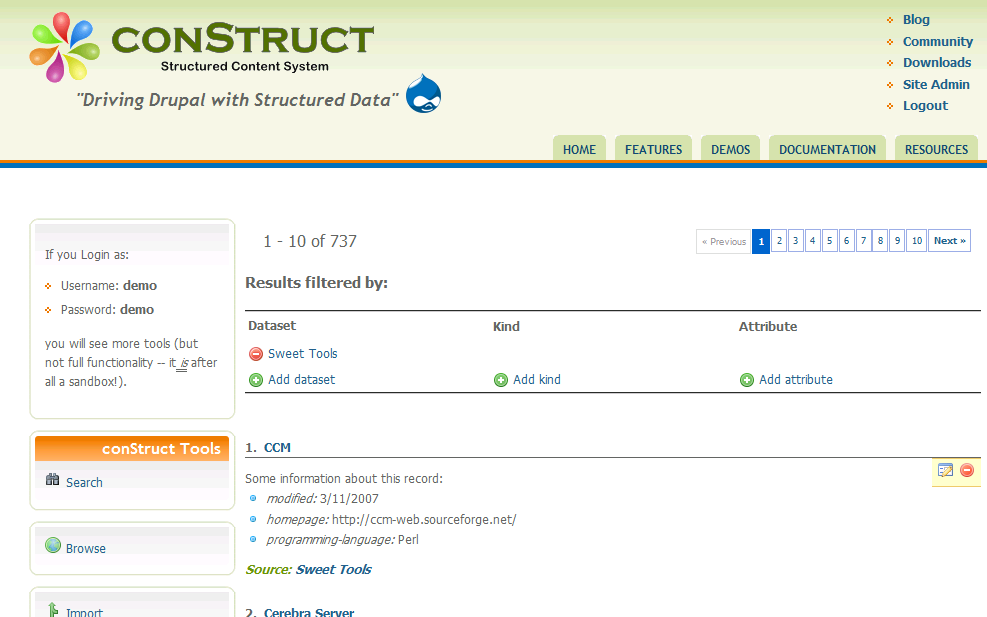 A completely new structured data view of the listing, courtesy of Structured Dynamics‘ structWSF and conStruct open source frameworks. This version can be viewed on the conStruct SCS Web site (pick the Sweet Tools dataset). You can compare this server-side presentation and version to the client-side JavaScript version using Exhibit that has been part of this blog for some time
 - A new structural organization of the tools into an ontology that relates portions of the ACM classification and UMBEL to the tools categories. This provides richer retrievals and inspections on the conStruct version (the Exhibit version remains fairly “flat” in structure)
- In light of the above, refined tools classifications, and, of course,
- The increase in coverage to 810 tools.
To see the major Sweet Tools page for this updated listing in its existing format, filter on ‘New’ under New or Existing? to see the recent additions. Alternatively, you can also see this same filtering using the conStruct structured data view by searching on the Status attribute using the value ‘New’; see example here.
Structured Data via conStruct
Though still formative, the most exciting change with the Sweet Tools listing is this new presentation via conStruct. It is a structured data Web services framework with a UI, all offered as a set of modules to Drupal. To kick the tires with this new system, you may want to look at:
- Browsing the ontology tree (then, Browse by Kind)
- Viewing an instance record
- Viewing a Class Type Report
- Viewing an Attribute Report
- Searching by facet (check the tabs)
- Doing a multi-value filtering (make selections from the various tabs)
- Exporting stuff in a variety of formats.
BTW, there are some helpful documentation pages that show how all of these various tools work and more, such as, for example, Browse. (Also, BTW, as a demo user, you also are not seeing all of the write and update tools, either; again, see the documentation.)
The essential underlying basis to conStruct is the structWSF Web services framework. There are still some aspects to this system that we feel are incomplete and we are working on. Some of these things include dropdown selections (controlled vocabulary selects); easier template creation; and intuitive template re-use. Nonetheless, these additions will come quickly, and what is here is already a great demonstration of how structured data can drive generic tools and interfaces.
The case study of how this system was constructed from a spreadsheet input using the irON vocabulary is described in an earlier post.
Updated Statistics
The updated Sweet Tools listing now includes nearly 50 different tools categories. The most prevalent categories are browser tools (RDF, OWL), information extraction, parsers or converters, composite application frameworks and general ontology tools. Each accounts for more than 8% — or more than 50 tools — of the total. This breakdown is as follows (click to expand):
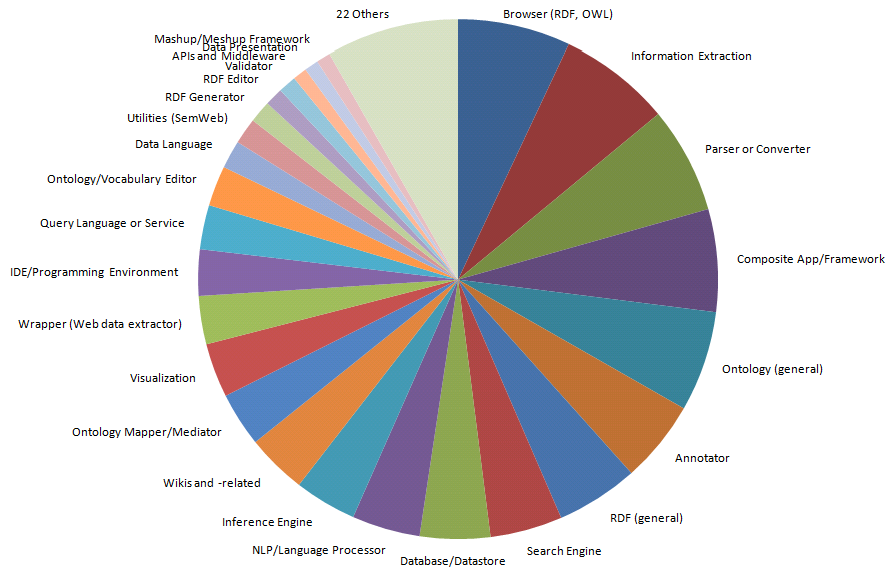 There are no real discernable trends in application tool categories over the past couple of years.
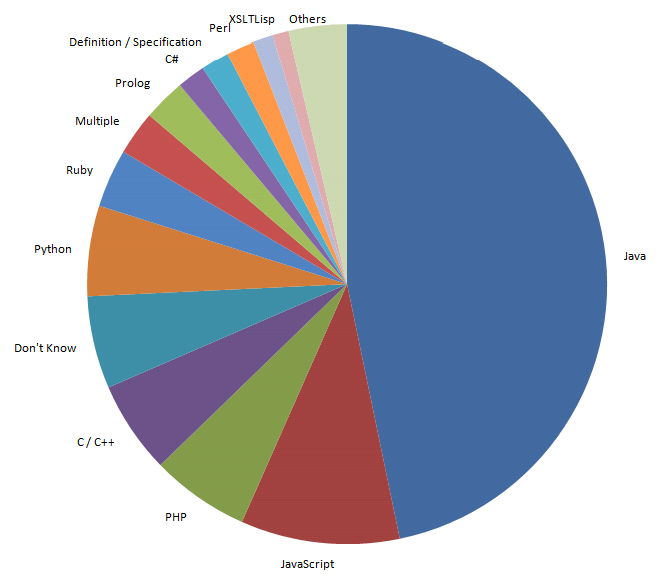
As for the languages these applications are written in, that has stayed pretty steady, too. Java is still the leading language at about 46%, which has been very slightly trending downward over the past three years or so. PHP has increased a bit as well. The current splits are (click to expand):
Prior Updates
Background on prior listings and earlier statistics may be found on these previous posts:
- Sweet Tools Updated to 736 Tools (February 2, 2009)
- Sweet Tools Listing Now Exceeds 700 Tools (July 5, 2008)
- Sweet Tools Updated, Opened for Collaboration (Mar. 31, 2008)
- Sweet Tools Updated to 650 Tools (Nov. 18, 2007)
- New Release: 578 Semantic Web and -related Tools (Sept. 16, 2007)
- 542 Semantic Web and -related Tools (Jun. 19, 2007)
- Listing of 500 Semantic Web and Related Tools (Mar. 11, 2007)
- Sweet Tools Updated to 420 Tools (Feb. 7, 2007)
- Converting ‘Sweet Tools’ to an Exhibit (Jan. 22, 2007)
- Permanent Sweet Tools Listing — 400+ Tools and Counting! (Jan. 5, 2007)
- Comprehensive Listing of 250 Semantic Web Tools (updated) (Oct. 4, 2006)
- Comprehensive Listing of 175 Semantic Web Tools (Sep. 22, 2006)
- Current Listing of 70 Semantic Web Tools (Aug. 12, 2006)
With interim updates periodically over that period.