

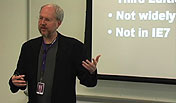
 Douglas Crockford, Yahoo!’s resident JavaScript guru and the developer of JSON, has provided a much-needed service in a three-part lecture series on the language. JavaScript is reportedly the second-fastest growing language to Ruby and has enjoyed a renaissance because of Ajax and rich Internet applications. JavaScript has always suffered from its unfortunate (and inaccurate) name, but it also suffers because of poor and outdated documentation and (general) lack of program comments or obfuscation to “minifying” to keep transferred script sizes small.
The first part in the lecture series (111 minutes) covers the basics of the language, its history and quirks:
- Part 1: 31 minutes | M4V download
- Part 2: 31 minutes | M4V download
- Part 3: 29 minutes | M4V download
- Part 4: 20 minutes | M4V download
- Download slides (zipped PowerPoint file)
The second part places JavaScript and its development in relation to the DOM and browser evolution (77 min):
Then, the third part covers more advanced language topics such as debugging, patterns and the interesting alternative to traditional object classing using prototypal inheritance (67 min):
Crockford is also the developer of the JSLint code-checking utility and has a Web site chocked full of other tips and aids, including a very good set of JS coding standards. I highly recommend you find the three or four hours necessary to give these tutorials your undivided attention.
 Crockford is generally disparaging about the state of most JavaScript books, though he does recommend the fifth edition of Dave Flanagan’s well-known JavaScript: The Definitive Guide. I know Doug has a real job, but all of us can hope he personally takes up the challenge of finally writing the definitive JavaScript guide. Crockford is definitely the guy to do it.
Because of the excellence of this series, it gets a J & D award.
 |
An AI3 Jewels & Doubloon Winner |